Write your website's service pages with AI: a step-by-step guide
How to use an AI assistant to turn what you already know about your work into clear service pages that answer customers' questions, without the generic filler.
 CirrumWeb studio for UK businesses
Published 4 min read
On this page
On this page
What you'll learn
- Why AI-written web pages often sound generic, and how to avoid it
- The customer questions every service page should answer
- A three-stage process, from interview to final edit
- What to check before the page goes live
This guide is for owners who know their work inside out but find writing about it painful, especially for their own website. AI assistants can help a lot here, as long as you use them to organise your knowledge rather than to invent copy from nothing. You’ll end up with pages that sound like you and actually answer the questions customers ask.
Why AI web copy often sounds generic
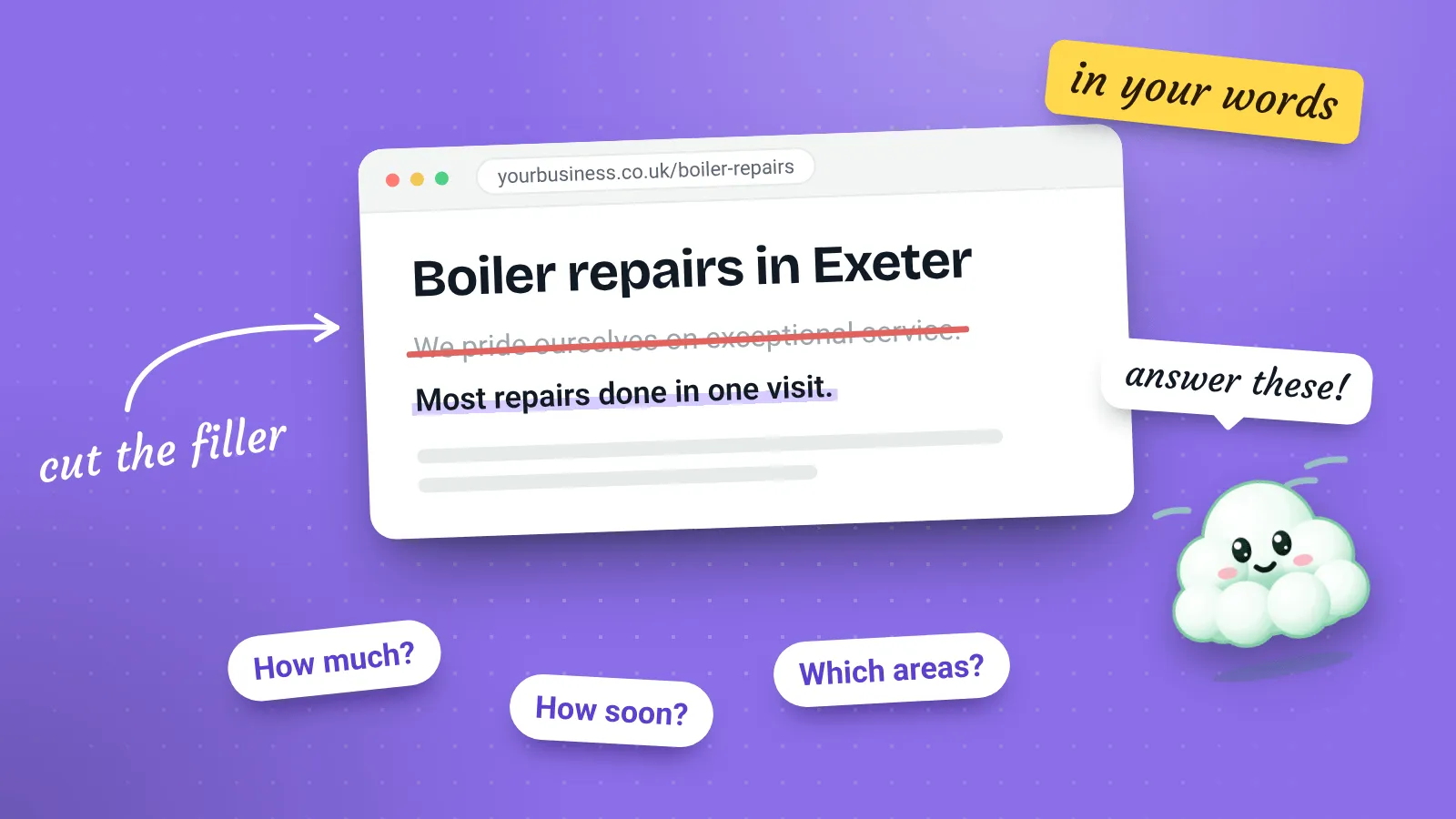
Ask an AI tool to “write a service page for a plumber in Exeter” and you’ll get something that could describe any plumber anywhere: “We pride ourselves on delivering exceptional service…”. It isn’t wrong, but it says nothing, and customers skim straight past it.
The fix is to give the tool the details only you know: the jobs you do most, how you price, what customers worry about, what makes you different. Then it has something real to work with.
Search engines want the same thing customers do
Pages that clearly answer real questions about a real service in a real place tend to be more useful to visitors, which is what search engines are trying to reward. Generic filler doesn’t help either.
The questions every service page should answer
Before writing anything, make sure you can answer these. If you can’t, that’s the page’s first gap.
- What exactly is the service, in everyday words?
- Who is it for, and who isn’t it for?
- What does it cost, or at least what does the price depend on?
- How long does it take, and what happens first?
- Why choose you over someone else?
- What do people usually worry about, and what’s the honest answer?
- What should they do next?
Stage 1: Let the AI interview you
Instead of asking the AI to write, ask it to ask you questions. This gets the knowledge out of your head without the pressure of a blank page.
I run [business name], a [type of business] in [area]. I want to write a page on my website about [service].

Interview me to gather what a customer would need to know. Ask one question at a time and wait for my answer. Cover what the service is, who it's for, pricing, timings, the process, common worries and why people choose me. After about 10 questions, summarise my answers as bullet points. Don't write the page yet.
Answer in whatever way is natural: short notes, long rambles, voice-to-text on your phone. You’re the expert, so the details are what count.
Use voice typing
Most phones let you dictate instead of typing. Talking about your work is usually quicker and more natural than writing about it, and the AI doesn’t mind the ums and ahs.
Stage 2: Turn your answers into a structured draft
Once you’re happy with the summary, ask for a draft built only from what you said.
Using only the facts in the summary above, write a service page for my website.

Structure:
- A clear heading that says what the service is and where
- A short opening paragraph for someone in a hurry
- Sections for: who it's for, what's included, pricing, how it works, common questions
- A final line inviting them to get in touch

Style: plain UK English, friendly and direct, short paragraphs. Don't use phrases like "we pride ourselves", "second to none" or "look no further". Don't invent any facts, prices, awards or reviews. If something's missing, write [ADD DETAIL].
Stage 3: Edit for truth, then for tone
Read the draft twice, with a different focus each time.
First read: is it true?
- Every price, time and promise is something you can deliver.
- Nothing has crept in that you didn’t say, such as an invented guarantee, a certification you don’t hold or a “fully insured” you haven’t confirmed.
- All the
[ADD DETAIL]gaps are filled or removed.
Second read: does it sound like you?
- Would you say each sentence to a customer standing in front of you?
- Is it specific? “Most boiler services take about an hour” beats “we work efficiently”.
- Is anything said twice? AI drafts often repeat the same point in different words.
Never let it invent reviews or results
AI tools will happily write “Our customers love us!” or “Hundreds of happy clients”. Unless you can back it up, remove it. Made-up testimonials and claims can mislead customers, and UK consumer protection rules treat fake reviews seriously.
Before the page goes live
| Check | Why it matters |
|---|---|
| The page title and heading say the service and the place | It helps both customers and search engines understand the page at a glance |
| Prices match the rest of your site and your quotes | Conflicting prices lose trust quickly |
| There’s one clear next step, such as a call, a form or a booking link | Visitors who are ready shouldn’t have to hunt for it |
| It reads well on a phone | Most visitors to small business sites are on their phones |
| Someone else has read it | A friend or customer will spot jargon you no longer notice |
A realistic expectation
This process won’t write a perfect page in five minutes. It turns a job most people put off for months into an hour or two of answering questions and editing. And because the facts all came from you, the page will be accurate and recognisably yours.